
The idea of roadschooling tends to arrive in two stages. First comes the excitement: the open road, the kids learning from the actual road trip instead of a textbook. Then comes the second stage, usually a few weeks later: okay, but how does this actually work?
If you're wondering how to homeschool while travelling Australia, you're not alone. Here is a practical starting point.
Roadschooling and Homeschooling are not quite the same thing
The terms get used interchangeably, but there is a useful distinction.
Homeschooling generally describes a family educating their children from a fixed home base, often following a structured curriculum or registered program with some regularity to the week. Roadschooling describes families educating their children while travelling, often without a fixed location for weeks or months at a time.
The legal registration requirements are usually the same. Most states do not distinguish between the two for registration purposes, but the day-to-day experience is quite different. A roadschooling family is working around changing locations, patchy internet, and a curriculum that ideally flexes around wherever the family actually is that week.
It tends to be less about replicating a school day and more about building a loose rhythm that travels well.
Check your State's Registration Requirements First
Before anything else, find out what your home state actually requires. Registration as a homeschooling family is a legal requirement in every Australian state and territory, but the process, the paperwork, and the level of detail expected all differ depending on where you are registered.
Some states ask for a loose learning plan, while others expect more formal documentation. Sort this out before you leave, not from a caravan park with patchy reception three weeks into the trip.
Decide on Structure before you Decide on Content
New roadschooling families often start by hunting for activities and worksheets. The more useful first step is deciding on a rhythm.
For example, you might choose to:
- Do a little learning each morning before driving.
- Use long stretches in the car for big questions and conversations.
- Save more structured lessons for rest days.
There is no universally right answer, but having a default rhythm means you are not negotiating it fresh every single day, which gets exhausting fast.
Use the Trip Itself as the Curriculum
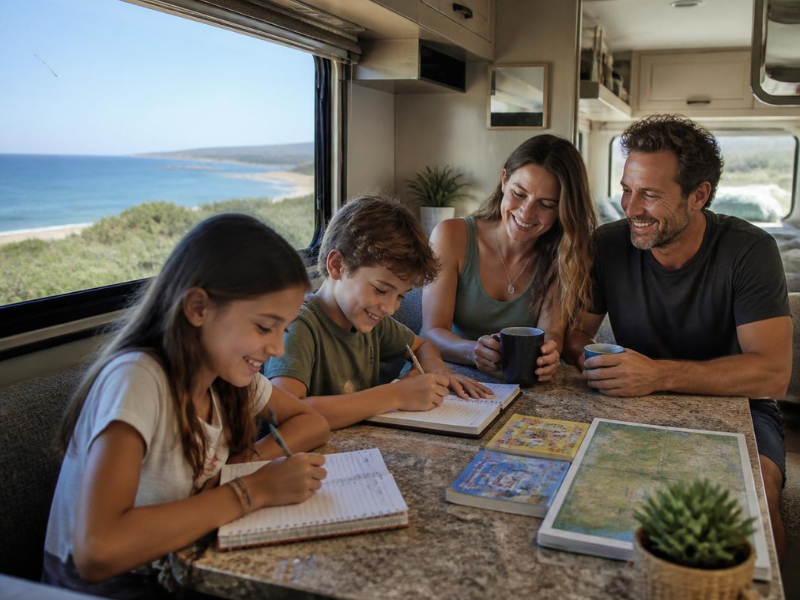
This is where roadschooling genuinely differs from school-at-home. A child working out fuel costs, reading a map, or asking why a town exists exactly where it does is doing real maths, literacy, and geography, not a substitute for it.
The biggest mindset shift for most new roadschooling parents is realising they do not need to recreate a classroom inside a caravan. The landscape is already teaching constantly; the parent's job is mostly to notice it and occasionally point it out.
Keep a Simple Record, Even a Loose One
Most states want some evidence that learning is occurring, and even where that is not strictly required, a simple record helps you see progress that can otherwise feel invisible day to day.
This does not need to be formal. Consider keeping:
- A notebook where your child writes or draws one thing they learned each day.
- A simple travel journal.
- A collection of photos with short captions about places visited.
Often, this is enough for both compliance and your own peace of mind. Do remember to check your state requirements, though!
Build in Grace for the Adjustment Period
The first two to three weeks on the road rarely look like the rhythm a family eventually settles into. Children are adjusting to a new environment, parents are still working out logistics, and everyone is more tired than expected.
Expecting a smooth, structured routine from day one tends to set families up to feel like they are failing at something that is actually just a normal transition.
Know that flexibility is not the Same as Falling Behind
A common worry among new roadschooling parents is whether missing a “normal” school structure will disadvantage their child.
In practice, most families find the opposite. Children doing real-world problem solving, meeting new people constantly, and adapting to changing environments are building skills that a standard classroom often cannot replicate at the same pace.
Structure still matters, but it does not need to look like a school timetable to be effective.
Find your Community Early
One of the most valuable things a new roadschooling family can do is connect with others doing the same thing, whether through online groups, regional meetups, or shared resources.
Beyond the practical tips, there is real value in simply knowing other families are navigating the same uncertainty, and that the wobbly first month is universal rather than a sign you are doing it wrong.
Learning how to homeschool while travelling Australia is less about creating the perfect plan and more about finding a rhythm that works for your family. What roadschooling does need is the willingness to adjust the plans and the knowledge that the learning happening outside the classroom counts for just as much as anything written on a page.
Thank you, Ashlee, from Wild School Collective, for sharing this insight into getting started with Roadschooling with our community. For support on your homeschooling journey while travelling, take a look at Wild School Collective.
