

There is a moment most parents recognise. Their child can recite the number. They can write it. They can correctly answer when asked which digits are in the tens place and which are in the ones place. They have done the worksheets. They have passed the test.
And then you ask them something slightly different, “show me what 67 actually means”, and you watch them pause. because the honest answer is, they don't quite know.
This is not a failure of effort or intelligence. It is a failure of visibility.
The Secret Inside Every Number
Here is what 67 actually means:
(6 x 10) + (7 x 1)
Six groups of ten with seven ones left over.
That structure, the multiplication and the grouping, is built into every number in our system. It is what makes numbers work. But here is the problem: that structure is completely invisible. When a child sees 67, they see two digits side by side. Nothing in the written numbers shows the multiplication. Nothing shows the groups.
This is not an accident of poor teaching. It is a genuine property of how written numbers work. The position carries the meaning, but position itself is silent. And silent things are very hard to teach.
A Journey That Took Thousands of Years
Here is something very few parents are ever told.
The way we write numbers today is the result of thousands of years of human ingenuity. Indian mathematicians who gave us zero, Arab scholars who carried the ideas westward, generations of teachers who found ways to make the invisible visible. Our number system is one of the most extraordinary intellectual achievements in human history. Your child is not just learning arithmetic. They are inheriting a conversation that has been running for three thousand years. That reframes everything. The depth underneath those ten small marks has to be nurtured. It cannot be rushed, drilled or handed to a child on a page.
More pages do not mean more understanding. A different workbook each year does not mean deeper learning.
What children need is time inside the right ideas. And those ideas are fewer than you think.
This is why products like the Linear Abacus Pocket Books are built around just five core activities. Not fifty. Not a year's worth of rotating content. Just five. Genuine understanding of place value does not require volume; it requires depth. We are not doing less. We are doing the opposite of what most resources do and that's going deeper into the ideas that matter, instead of wider across ideas that don't yet have roots.
What Happens When Children Miss It
When children learn number names without learning the structure, a predictable set of difficulties follows. The child who can count to one hundred but doesn't understand why they say ‘ten' after ‘nine'. The child who adds two digit numbers by following a procedure but cannot explain why it works.
These are not random gaps. They are all the same gap, showing up in different places.
This is often where parents begin searching for how to teach place value in a way that builds genuine understanding rather than simply teaching another procedure. The child has learned the surface, the symbols, names and procedures without learning every being shown the structure underneath.
The Conversation That Changes Everything
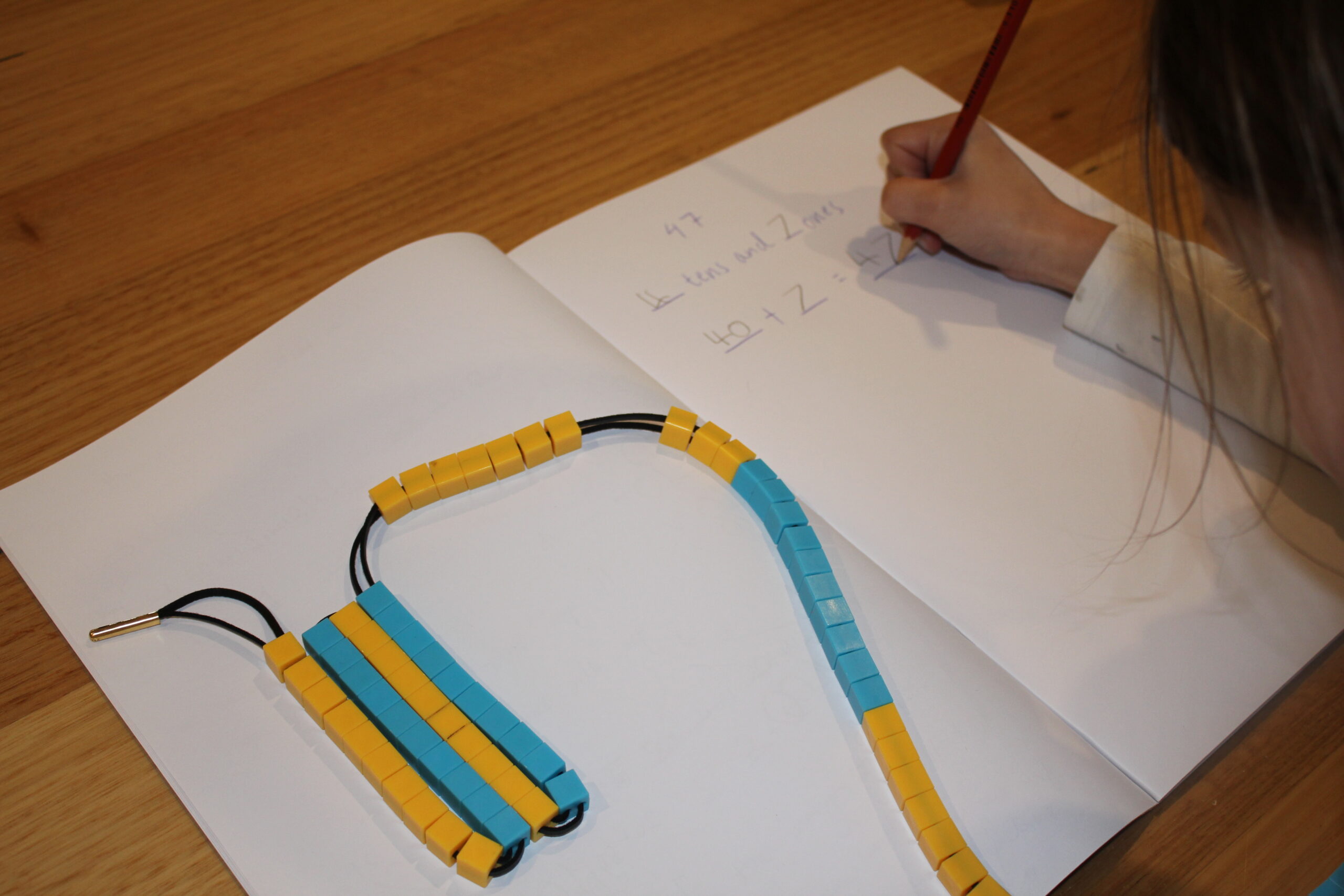
When a parent sits down with a child and a string of beads and starts genuinely exploring, not instructing, not drilling, but simply investigating together, something begins to shift.
“How many beads do we have? How many groups of ten can we make? What's left over? Now, what does 6 in 67 actually mean?”
The child counts, groups, builds and then, often quite suddenly, understands something that no amount of rule recitation ever made clear. The 6 in 67 is not just a digit in a position. It is a count of groups, and now they can see the groups, because they made them.
If you've ever wondered how to teach place value without turning maths into a series of rules and worksheets, the answer may be simpler than you think.
You do not need to be a maths expert. You need to be curious alongside your child, and once that foundation is secure, something remarkable happens; the same understanding that explains numbers also unlocks the metric system. The same string of beads that counts to 1,237 also measures 12 metres and 37 centimetres, because the metric system was deliberately designed to match the base ten number system exactly.
One discovery. Two subjects. That connection is never made explicit in most maths classes. With the Linear Abacus, children find it themselves.
The place value crisis is real. Parents feel it at the kitchen table. But it is not inevitable. The hidden structure of numbers can be made visible with just five activities, a string of beads and a genuine conversation.
Thank you to Genovieve from Linear Abacus for sharing these insights with our community. For more information about the Linear Abacus and their supporting resources, see their detailed listing in the Homeschool Resource Directory.
