
5 Practical Teaching Strategies to Help Your Child Learn Their Way

One of the greatest advantages of homeschooling is the freedom to teach children in a way that works for them. For neurodivergent children, particularly those with ADHD, autism, dyslexia or other learning differences, this flexibility can make a tremendous difference.
Over my years of teaching, I’ve come to appreciate just how differently children process information, manage their attention and approach new challenges. Some children need to move to concentrate. Others need more time to process instructions. Some grasp complicated ideas quickly but struggle with tasks that appear relatively simple.
The important thing is recognising that children don’t all need to learn in the same way, or at the same pace.
Here are five approaches I encourage homeschooling families to consider, many of which have shaped the way I teach.
1. Establish a predictable rhythm, but keep it flexible
Many neurodiverse children benefit from knowing what comes next. Predictability can reduce anxiety, make transitions easier and free up mental energy for learning.
However, there’s an important difference between having a rhythm and following a rigid timetable.
Instead of planning every minute of your homeschooling day, create a familiar sequence of activities. You might begin with movement, move into literacy or numeracy, take a break outdoors, then return to another learning activity.
Try using a simple visual schedule so your child can see what’s coming. For children who struggle with transitions, a gentle reminder before changing activities can also help.
A familiar rhythm in learning can make a real difference. I like to introduce new ideas in small, manageable steps, building on what children already know. Repetition and consistency help children feel more confident about what they’re doing, while still allowing them to progress at their own pace.
My tip: Keep the order of your day reasonably consistent, but be prepared to change the timing. A child who needs an extra 15 minutes outside may return much more ready to learn.

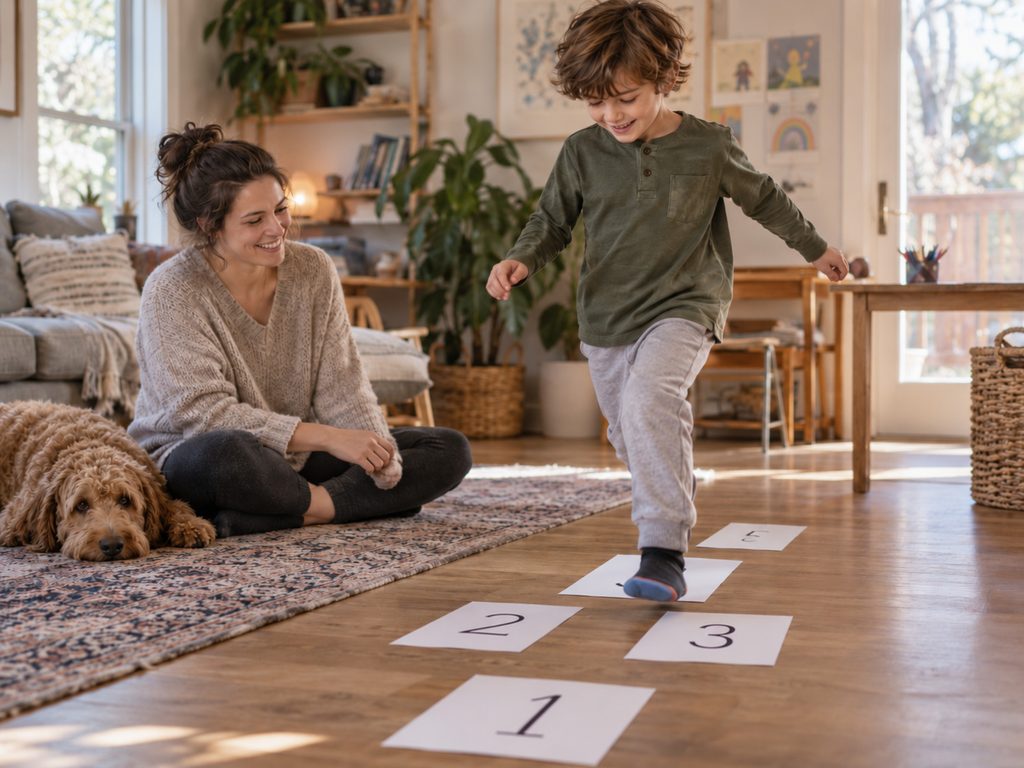
2. Bring movement into learning
We often associate concentration with sitting quietly at a desk. But for some children, particularly those with ADHD, movement can actually support attention and engagement.
A 2023 review by Song and colleagues, examining 24 studies involving 914 children and adolescents with ADHD, found that physical activity interventions improved aspects of executive functioning, including working memory, inhibitory control and cognitive flexibility.
Learning doesn’t always have to happen while sitting down.
Try practising times tables while jumping on a trampoline, spelling words with large arm movements or counting steps as you walk around the garden.
This is something I incorporate regularly into my teaching. In early numeracy, we use songs, clapping, rhythmic counting and movement activities to explore number patterns. When learning multiplication, for example, children can practise skip counting through movement before progressing to written equations.
In literacy, I introduce letter sounds through actions, stories and physical activities before asking children to write them.
My tip: If your child is struggling to concentrate, try changing how they’re learning before assuming they’re unwilling to learn.
3. Make learning something children can see and touch
Abstract thinking develops over time, and many children benefit from experiencing a concept physically before being expected to understand it on paper.
Research supports this approach. A 2013 meta-analysis by Carbonneau, Marley and Selig examined 55 studies involving more than 7,000 students. It found that teaching mathematics with physical manipulatives produced better learning outcomes, on average, than instruction using abstract symbols alone.
Consider teaching addition using blocks, beads or household objects rather than beginning with written equations.
When teaching place value, physically grouping objects into tens and hundreds allows children to see how numbers work.
This approach is fundamental to the way I teach mathematics. Children begin with practical materials such as number rods, counting tools and Montessori-inspired manipulatives. As their understanding develops, we gradually move towards written and mental strategies.
Literacy can be approached similarly. Children might form letters using modelling clay, build words with letter cards or practise handwriting through drawing and craft activities.
These activities aren’t simply extras to make lessons more enjoyable. They help children build an understanding of what they’re learning.
My tip: Whenever a concept feels difficult, ask yourself whether you can make it visible, physical or practical.

4. Teach at your child’s current level, not their age
One of the difficulties children can experience in traditional classrooms is being expected to progress through learning at the same rate as their peers.
Yet children’s abilities rarely develop evenly.
A ten-year-old might have an excellent vocabulary and a wonderful imagination but still find spelling or handwriting challenging. Another child might be confident with multiplication while needing more support with basic number relationships.
This is sometimes described as an uneven learning profile, and it’s particularly common among neurodiverse learners.
When homeschooling, you have the opportunity to respond to those differences.
Rather than working backwards from what a child should know at a particular age, begin by identifying what they already understand. Then introduce the next manageable step.
In my literacy and numeracy teaching, I organise learning into progressive stages. Children can begin at the point that matches their current understanding and move forward as they’re ready.
I also encourage families not to rush foundational skills. Taking additional time to develop a secure understanding now can make more advanced learning much easier later.
My tip: Measure progress against where your child was last month, rather than where another child is today.
5. Protect your child’s confidence and enjoyment of learning
Perhaps the most important consideration of all is how your child feels about learning.
Some neurodiverse children arrive at homeschooling after experiencing considerable frustration or anxiety at school. They may have begun to associate academic work with failure, even when they’re capable and curious learners.
Rebuilding confidence takes patience.
Begin with achievable tasks and provide opportunities for success. Notice effort, persistence and growing independence, rather than focusing exclusively on correct answers.
Give children opportunities to explore subjects they find interesting, and remember that breaks, creative activities and time outdoors are valuable parts of their day.
I love using storytelling, art, music and practical experiences in teaching because they create different pathways into learning. A child who struggles with a written explanation may understand the same concept beautifully when it’s presented through a story or hands-on activity.
And when something isn’t working, it is perfectly reasonable to stop, approach it differently and try again another day.
My tip: End a learning session while your child still feels capable, rather than pushing through until they’re frustrated or exhausted.
Finding what works for your family
There is no single teaching method that suits every neurodivergent child. What works wonderfully for one child may be completely unsuitable for another, even when they share the same diagnosis.
That’s why observation is such an important part of homeschooling.
Pay attention to when your child is most engaged, what environments help them concentrate and which activities leave them feeling successful.
You don’t need to change everything at once. Start with one or two small adjustments and see what difference they make.
Above all, remember that education is not a race. The aim is to help children develop knowledge, skills, independence and a lasting relationship with learning.
And sometimes, the greatest progress happens when we give children the time, space and freedom to learn in their own way.
Frequently Asked Questions About Homeschooling Neurodiverse Children
What are the benefits of homeschooling a neurodiverse child?
Homeschooling can give neurodiverse children greater flexibility in how, when and where they learn. Families can adjust routines, provide movement breaks, use hands-on activities and allow more time to practise challenging skills. This flexibility can help parents respond to their child’s individual learning needs, interests and pace of progress.
How do you homeschool a child with ADHD?
When homeschooling a child with ADHD, consider using a predictable but flexible routine, breaking learning into manageable steps and incorporating regular movement breaks. Short, engaging activities and practical learning experiences may also help maintain attention. Observe how your child responds and adjust your approach rather than expecting them to learn in one particular way.
How can you adapt homeschooling for an autistic child?
Every autistic child has individual strengths, preferences and support needs. Some children may benefit from visual schedules, clear instructions, predictable routines and additional time to transition between activities. Others may need adjustments to lighting, noise or other sensory aspects of their learning environment. Start by observing what helps your child feel comfortable, engage and ready to learn and adapt your approach to suit them.
What is the best homeschool routine that works for every neurodivergent child?
There is no single routine that works for every neurodivergent child. Many families find it helpful to establish a familiar sequence of activities while allowing flexibility around timing, breaks and energy levels. A simple visual schedule, regular opportunities for movement, and a balance of focused learning and preferred activities can provide structure without making the day feel rigid. The aim is to find a rhythm that supports your child’s learning and wellbeing.
Thank you, Francean (Fran) McCall, founder and teacher behind Functional Education, a New Zealand-based home education programme offering structured, video-based lessons for Australian and New Zealand homeschooling families. Find out more by visiting the directory listing for Functional Education.
References and Further Reading
Song, Y., Fan, B., Wang, C., & Yu, H. (2023). Meta-analysis of the effects of physical activity on executive function in children and adolescents with attention deficit hyperactivity disorder. PLOS ONE, 18(8), e0289732.
https://doi.org/10.1371/journal.pone.0289732
Carbonneau, K. J., Marley, S. C., & Selig, J. P. (2013). A meta-analysis of the efficacy of teaching mathematics with concrete manipulatives. Journal of Educational Psychology, 105(2), 380–400.
Zhu, X., et al. (2023). Comparative effectiveness of various physical exercise interventions on executive functions and related symptoms in children and adolescents with attention deficit hyperactivity disorder: A systematic review and network meta-analysis. Frontiers in Public Health, 11, 1133727.
