
Our Homeschooling Background and Tutoring Background
I have an eight year old boy who, like his adult brothers, has been homeschooled since birth. He has no particular learning challenges and is working roughly at a Grade 3 level in maths.
However, I am also a tutor to many students with additional needs, from both homeschool and traditional school backgrounds. I used the Numero card game with virtually all of my students.
What Is the Numero Card Game Like?
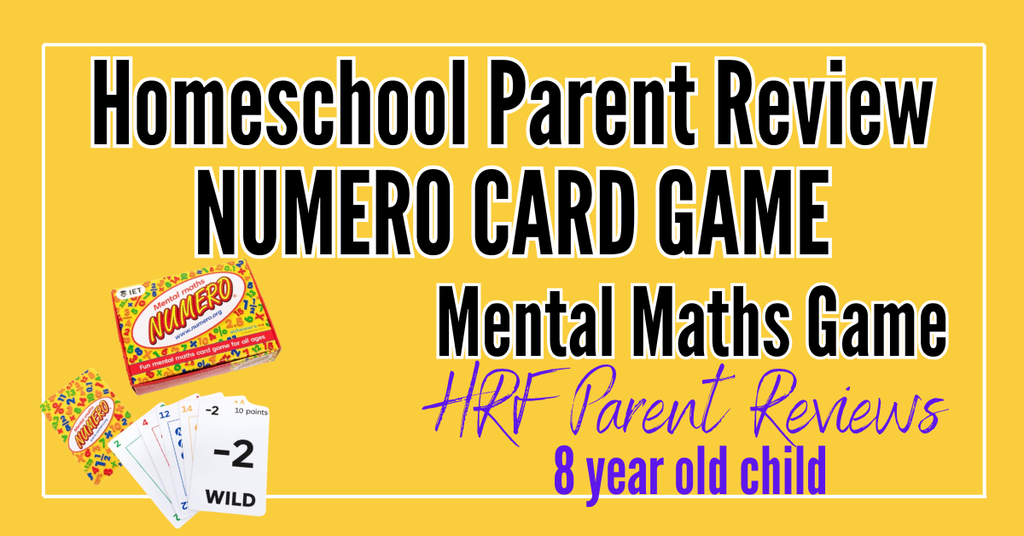
The Numero game comes packed in a slightly non-traditional box format for a card game. It also comes with extensive instructions. I found the length of the instructions rather daunting at first and put off starting to play until I had a spare hour to digest them.
However, once I did, I found that the basic game is very straightforward and extremely well thought out. Unlike most maths games that are thinly veiled drills (and the kids see right through this), Numero is a game that involves strategy, chance and mental mathematics skills. While chance does play a part, your strategic and mathematical ability strongly influence your ability to win. This is a major win.
One thing that is excellent about the games is the ability to set the level of difficulty, from easy enough for a six or seven-year-old to play all the way through to adult-level arithmetic. I’ve never seen such an adaptable and sophisticated game before.
The cards themselves are very pleasing to use. They’re just the right size to hold and shuffle and they are plastic coated to make shuffling a breeze. For an “all thumbs” shuffler like me, that’s gold.
Our Experience using Numero for Homeschool Maths
A typical Numero game lasts around 15 minutes, which is an ideal length to fit in around just about any day in our busy household. It also fits neatly into a one or two hour tutoring session as an end of the session reward or to “reset” a student when their attention wanes.
I played Numero with my boy daily for several weeks. Eventually, he got tired of playing it so often, but he still enjoys playing it at least weekly.
I found Numero is an excellent way to encourage number sense because, to play it well, one must think about all the possible ways numbers can be combined to form other numbers.
The basic game begins with addition, and then the extensions in the form of wild cards expand the maths to include:
- Subtraction
- Multiplication
- Division
- Fractions
- Powers and roots
Since my boy is in Year 3, we have only just expanded to subtraction and multiplication and divsion by 2 and 5. He is capable of higher levels of multiplication and division but, with the added complication of strategy, the arithmetic becomes more challenging.
I installed the Numero app on my boy’s computer, and he enjoyed using it, as it did not require him to remember to keep drawing new cards. He did, however, find it more challenging because the computer was less inclined to give him “some slack” by deliberately ignoring opportunities than I was.
Incidentally, replenishing their hand is one aspect of gameplay that I found all my students struggled to remember to do. I take this as evidence that the game engages many neural pathways, so it’s not really a bug, but it does need to be managed by a patient adult.
Using Numero With Students With Additional Learning Needs
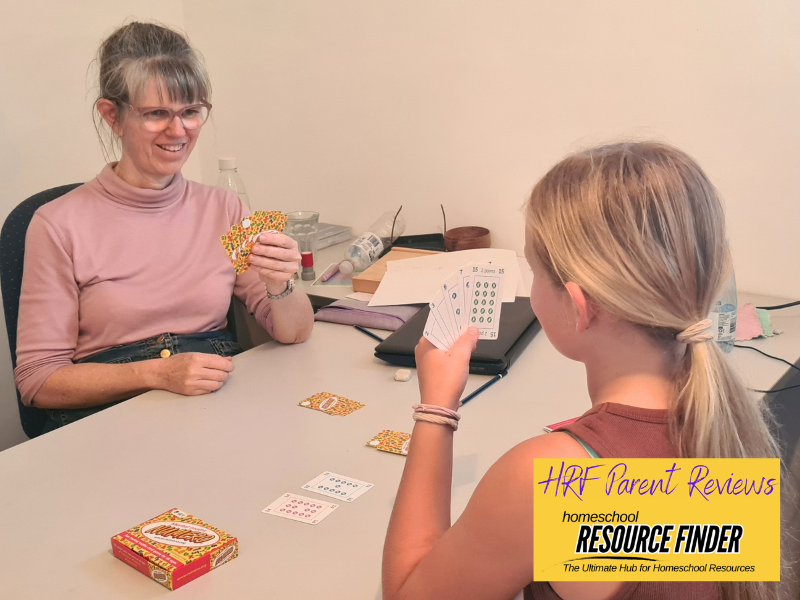
I also played Numero with most of my tutoring students at least once. One particular group I played it with on several occasions was a group of three students with significant learning challenges who are very difficult to engage in any formal learning. Numero was an instant hit with them; the eldest of the group declared it to be “fantastic!” I have recommended the game to all of my clients’ parents.
What Skills Does Numero Help Develop?
Numero helps to develop both basic arithmetic skills and deeper number sense. It also develops strategic and analytical thinking.
In my experience, playing the game encourages children to think about numbers in different ways while combining mathematical understanding with decision making and strategy.
Are There Any Limitations to the Numero Card Game?
While I believe Numero is an excellent supplement for any maths program, I do not believe it would be able to completely replace a more structured drill program.
Also for very young children or those with weaker mathematical ability, you do have to intentionally teach them how to apply the maths they should know to the game.
For some children, the combination of game strategy (which is quite sophisticated in Numero) and mental arithmetic presents quite a cognitive load challenge. This is not a showstopper, but it does need to be managed with careful teaching.
Fortunately, Numero provides many excellent resources for doing just that, including rules posters that give hints as to when and how to apply the various game strategies and moves.
Who Is the Numero Card Game Best For?
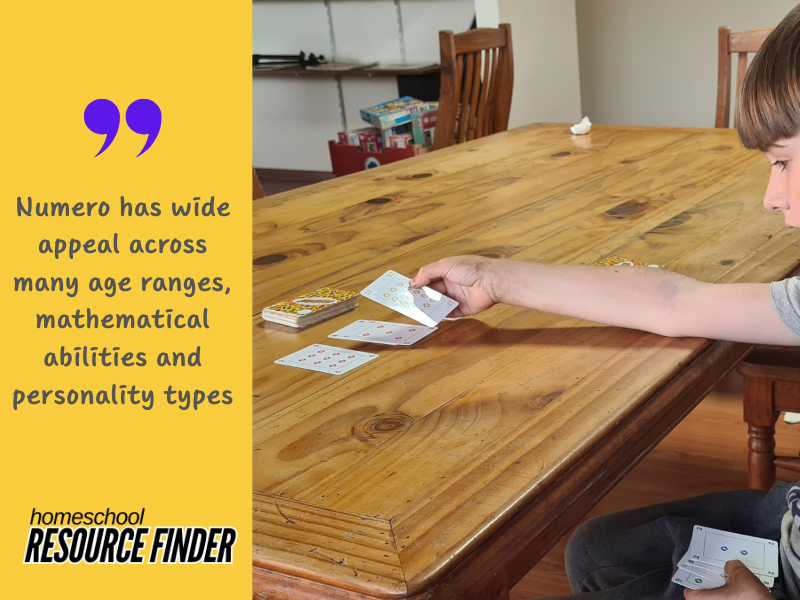
Numero has wide appeal across many age ranges, mathematical abilities and personality types. My father enjoyed playing it for an entire morning with my boy when he was visiting from interstate. I believe its adaptability makes it a useful resource for a range of learners, whether they are homeschooled, attend a traditional school or are working on their maths skills in a tutoring environment.
Our Final Numero Card Game Review and Recommendation
I will most definitely continue using and recommending the game, both to my clients and to anyone with kids, homeschooled or otherwise. In fact, earlier in the year my local librarian recommended Numero to me. I hesitated when I saw the cost, which seemed a bit much for what looks like not much more than a standard deck of playing cards.
But the cost is well justified for the quality of the product and for what is really an infinite array of game possibilities.
I’m very happy for the opportunity to review the product and I now intend to buy extras sets to use in my tutoring.
Homeschool Parent Kathy completed this parent review of the Numero Card Game with her 8-year-old child and tutoring students of varying ages. The review period was conducted between August and September 2026.
