
While homeschooling often focuses on measurable academic subjects like science, mathematics and literacy, it is often the quiet, everyday moments that offer the most profound learning opportunities.
Learning how to recognise emotions, manage frustration, communicate with others, solve problems, show empathy and bounce back when things don’t go to plan are all important skills for life. And the good news is that homeschooling can provide countless opportunities for social and emotional learning at home, without adding another subject to your timetable.
What is social and emotional wellbeing?
Social and emotional wellbeing is about helping children understand themselves, relate positively to others and navigate the ups and downs of everyday life.
This might include learning to:
- Recognise and name different emotions
- Express feelings in healthy ways
- Manage frustration and disappointment
- Understand other people’s perspectives
- Build positive relationships
- Make decisions and solve problems
- Develop confidence and independence
- Cope with mistakes and setbacks
These skills don’t develop overnight. They grow gradually through everyday experiences, conversations and relationships.
Everyday moments are learning opportunities
One of the wonderful things about homeschooling is that learning doesn’t have to be confined to a desk. If your child becomes frustrated because a model they are building isn’t working or they are not understanding a tricky maths concept, that’s an opportunity to talk about perseverance and problem-solving.
When siblings disagree over whose turn it is, that’s an opportunity to practise communication, compromise and empathy. Or if a recipe doesn’t turn out as expected, that’s an opportunity to talk about mistakes, flexibility and trying again. Even deciding what to do on a rainy afternoon can involve negotiation, decision-making and considering other people’s ideas and opinions.
Instead of viewing these moments as interruptions to learning, try seeing them as part of the learning itself.
Why not explore Twinkl’s resources to find simple, engaging ways to support your child’s social and emotional wellbeing at home? Start your free trial today and discover a wealth of resources designed to make everyday learning and family life a little easier.
Help children put feelings into words
Children don’t always have the words to explain what they are experiencing. Sometimes “I’m angry” might actually mean “I’m disappointed”, “I’m overwhelmed” or “I don’t know how to fix this”.
Regularly talking about emotions can help children develop a larger emotional vocabulary.
When circumstances arise, you might consider asking:
“How do you think that made them feel?”
“What do you notice in your body when you’re frustrated?”
“What could you try if you feel like giving up?”
Here are our Top 3 Twinkl resources that will help you start conversations about feelings:
- Confidence Boosting Conversation Cards
- My Strengths Activity
- What Are Your Strengths PowerPoint and Google Slides
Help children learn about emotions with Twinkl’s Original eBooks
Books are another wonderful way to explore emotions. Characters give children a safe opportunity to talk about feelings, friendships, challenges and difficult decisions without having to talk directly about themselves.
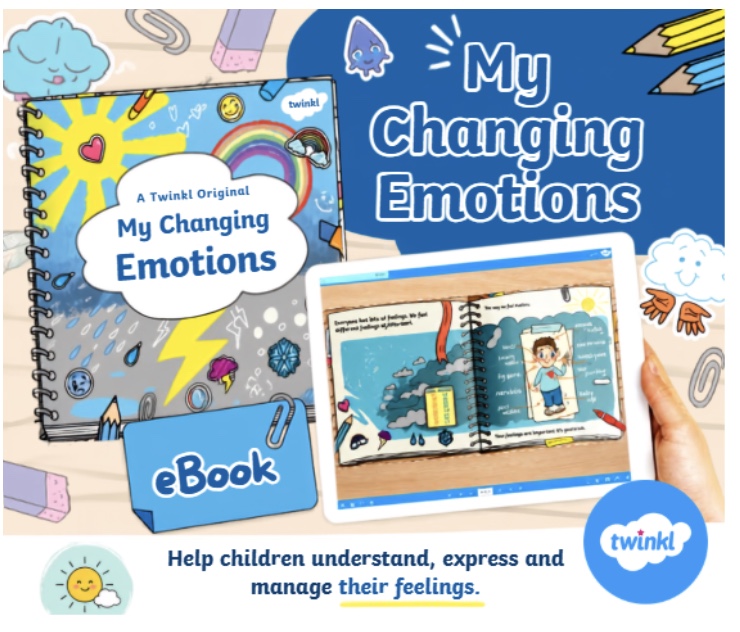
My Changing Emotions eBook focuses on some of the main emotions children experience, including happiness, sadness, love, fear and anger. With accessible language and delightful illustrations, it introduces children to the various parts of the brain that are responsible for different emotions, and helps them understand how to deal with emotional changes.
To help you teach this topic in more depth, we’ve created various teaching resources and activities based on the ebook. These include PowerPoints, posters, board games and much more. Take a look at our full collection of My Changing Emotions resources to choose your favourites. An example of one of the resources included is the Cup of Tolerance Worksheet, where children can work on what makes them feel overwhelmed. Make sure you check out our Family and Identity resources too.
Give children opportunities to make decisions
Independence is another important part of emotional wellbeing. Homeschooling naturally provides opportunities for children to take ownership of their learning and everyday routines. Depending on their age, you might allow them to choose which book to read, plan part of the day’s activities, prepare lunch, organise their workspace or decide how they would like to complete a project. You don’t need to hand over complete control. Offering two or three appropriate choices can be enough to help children feel that their opinions and decisions matter.
You might like to explore our visual schedule resources and work with your children to plan out your days.
Normalise mistakes
One of the greatest gifts we can give children is the understanding that making a mistake doesn’t mean they have failed. When something goes wrong, try asking: “What happened?” “What could we try differently?” or “What did we learn?”
This shifts the focus from getting everything right to learning from experience. Homeschooling can be particularly well suited to this approach as children often have the flexibility to revisit something, try again and work at their own pace.
This poster is an ideal resource for children who find making mistakes challenging. It provides children with suggestions for things they can do to overcome making a mistake and continue on with their learning.
Don’t forget connection
Social development doesn’t require a classroom. Children develop social skills through friendships, extended family, community groups, sporting activities, hobbies, volunteering, playdates and everyday interactions with people of different ages.
The goal isn’t to recreate school at home. It’s to provide children with meaningful opportunities to connect, communicate and participate in the world around them. These experiences are an important part of social and emotional learning at home.
Free resources to support social and emotional learning
You don’t need elaborate lessons to support your child’s wellbeing. A few conversation starters, feelings activities, mindfulness exercises or friendship resources can provide a useful starting point.
In addition to the free resources linked throughout this article, the following list of resources may also prove helpful for your learning at home. These can be used as part of a lesson, during quiet time or simply when a particular situation provides a natural opportunity to talk.
- Free Parent Guide to Social and Emotional Regulation
- Free Mindfulness Colouring Pack
- Free Compliments Flyer
Most importantly, remember that supporting your child’s wellbeing isn’t something you need to “fit in” around homeschooling. It is homeschooling.
Every conversation, challenge, friendship, mistake and small moment of independence is helping your child develop the skills they will carry with them long after they have finished their formal education.
⭐️ Thanks to the team at Twinkl for sharing these helpful tips with our community. For more information about Twinkl, their free trial and their ever-expanding range of educational resources, see their detailed listing in the Homeschool Resource Directory.
Frequently Asked Questions
Social and emotional learning in homeschooling is about helping children develop skills such as emotional awareness, self-regulation, empathy, communication, problem-solving and resilience. These skills can be developed naturally through everyday activities, conversations, relationships and experiences, without needing to add a separate subject to your homeschool timetable.
You can teach social and emotional skills through everyday situations, such as resolving disagreements, managing frustration, making decisions, learning from mistakes and considering other people’s feelings. Reading books, using conversation cards, exploring emotions and participating in group activities can also help children develop these important life skills.
Homeschooling does not prevent children from developing strong social and emotional skills. Children can build friendships, develop communication skills and learn to interact with others through community groups, sporting activities, hobbies, playdates, volunteering and extended family relationships. Providing regular opportunities for meaningful social interaction helps children develop confidence and positive relationships.
