
If you're in the market for a maths curriculum, you've probably heard two terms bandied about: mastery learning and spiral learning. If you don't know what these mean, you've come to the right place! We're going to look at what both of these methods are, explore the strengths and weaknesses of both, and assess the best way for kids to learn maths.
Defining the Maths Approaches
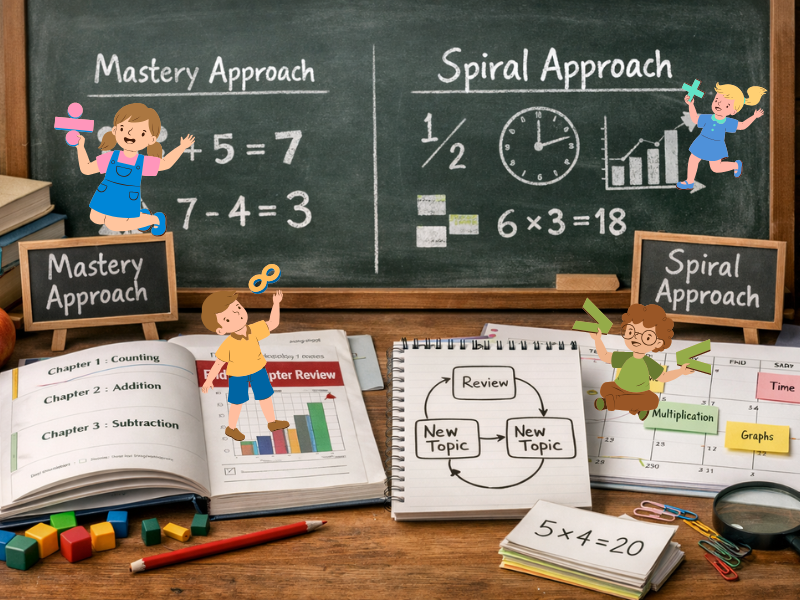
Curricula which focus on mastery are typically organised into units or chapters and often boast relatively few broad “topics” per year. A child might work on counting for a few weeks before moving to addition for a month, then subtraction for a period, and so on. In mastery programs, end-of-chapter reviews typically only focus on the material covered in that chapter and occasionally (typically 2 to 4 times per year) there will be a general review of what has been covered to that point.
Spiral curricula keep revisiting the same material over and over while introducing a new topic much more frequently: sometimes daily, sometimes weekly. The most extreme examples of spiral programs tend to spend a lot more time on review than on new material and this is a common criticism. However, if you take a “high-level” look at the Australian Curriculum for mathematics, and even all of the mastery programs, you'll notice that it is actually a very slow spiral: the same concepts are revisited year after year at increasing levels of complexity.
Comparing the Maths Approaches: Pros and Cons
The advantages of a mastery maths curriculum for homeschooling include:
- Children have the time to get familiar with a particular topic before moving on, which reduces confusion and increases depth of knowledge
- When taught as intended, a child demonstrates understanding of one skill before moving forward to the next, helping to ensure there are no learning gaps
- Allows the parent some flexibility to choose the order of presentation of topics, including running some topics in parallel when appropriate
The disadvantages of a mastery maths curriculum for homeschooling include:
- Generally requires more parent involvement to direct the pace and order of learning
- Without intentional review, children may forget earlier concepts
- When topics return the following year, some relearning is often needed
- The pace can feel too slow for some children
The advantages of spiral maths curriculum for homeschooling include:
- Constant review means that a child is unlikely to forget — something many parents find helpful
- Lessons tend to follow a consistent format, supporting children who thrive on routine
- Adjusting the pace can be easier within a well-designed spiral program
The disadvantages of a spiral maths curriculum for homeschooling include:
- Some children find frequent topic changes confusing
- Understanding can remain shallow if concepts are introduced too quickly
- If a child misses a concept, repeated reviews can become frustrating
Evaluating the Maths Approaches: Which Works Best?

If you look carefully at the definitions of both mastery and spiral curricula, you might notice that they are actually two ends of a spectrum. In practice, all maths curricula are spiral in nature — the only difference is the length of one “lap” of the spiral. As with most things, the optimal position sits somewhere in the middle, and this is often what is considered the best way for kids to learn maths.
The ideal learning presentation for maths is a combination of the mastery and spiral methods as defined above. A moderate number of topics should be presented each year. Each unit of study should be short enough to maintain the child's motivation, but long enough to allow time for concepts to “sink in” and for related ideas to be explored together.
At the same time, each lesson should incorporate review to keep important skills and facts fresh. Any maths curriculum or teaching plan at the primary school level should also include regular practice of basic maths facts, as these form a vital foundation for higher-level mathematics.
This is the approach that Milestone Maths adopts. Each milestone (or unit of work) runs for approximately one to three weeks and focuses on one particular topic. Importantly, each lesson is linked to prior knowledge, with explicit references to previous lessons. Connections to everyday experiences are also highlighted, helping children develop a deeper understanding of each concept and how it applies in real life.
At the same time, each lesson includes up to a page of review activities to reinforce previously learned concepts. There is also an optional drill at the end of each lesson. While it may seem simpler to separate these drills into another resource, including them within the lesson reduces friction for children and keeps everything in one place.
The Best of Both Worlds
When it comes to teaching mathematics, neither the pure mastery nor the pure spiral approach is perfect on its own. The most effective curriculum combines the strengths of both: it provides the time and focus needed for deep understanding while consistently reviewing to ensure knowledge is retained for life. Ultimately, this balanced approach reflects what is the best way for kids to learn maths — building a strong, lasting foundation while keeping learning engaging and meaningful.
Thanks to Kathy from Milestone Maths for sharing this insight with our community. To find out more about the Milestone Maths program, see their detailed listing in our Homeschool Resource Directory
